[Week 15] Built Drone Simulator

1. Simulator Structure

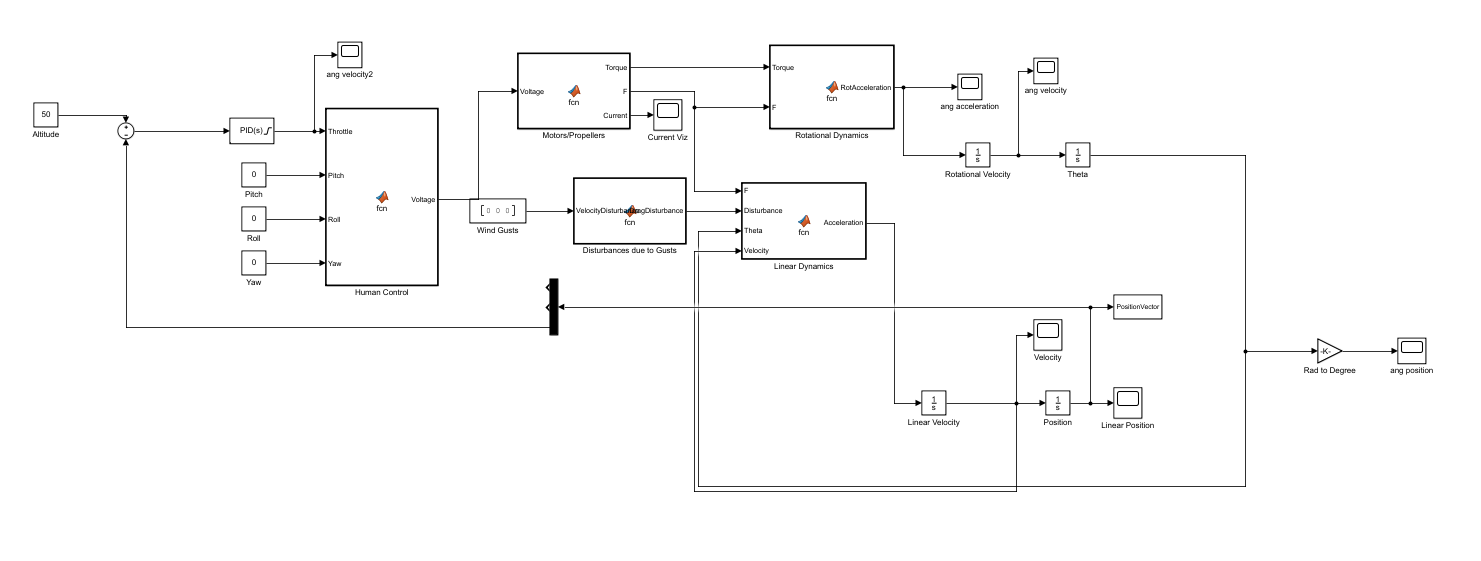
Simulated quadcopter model using Matlab Simulink. The simulator consists of sub-parts, propeller, rotational dynamics and linear dynamics. Each

Sub-parts

Propeller

Propeller's torque, force and current change according to voltage

Rotational Dynamics

Drone's moment of inertia according to torque and force

Linear Dynamics

Acceleration of drone according to force, angle and velocity

Set Starting Position

Change starting position from coordinate system

2. Simulator


  •  Open loop simulator
  •  Close loop simulator  - Z axis

  •  Close loop simulator - X, Y, Z axis


3. Results

  • Open loop

  • Close loop - Z axis

  • Close loop - X, Y, Z axis

Comments

Popular posts from this blog

[Week 16] Final Blog Post and Demo Video

1. Final Simulator Application The completed project allows the user to simulate the control algorithms that are used to control UAVs. The simulator created models the dynamics and generates the motor voltages that are used to control UAV during flight. Disturbance functionality is also included but hasn't been tested extensively. The final application shows the PID output compared to the desired motor output and shows an animation of the altitude controlled flight. Two control schemes are presented, open loop and closed loop control. The final application shows the trajectories generated by these control schemes to allow for a visual comparison. Sub-parts Altitude Controller Open Loop Controller Closed Loop Controller Final UI Data Display     2. Demo Video The video included below is the final demonstration for the simulator application.   https://youtu.be/fAxl8cEhzJ4

[Week 7] Ideation and Brainstorming for Topic Selection

Date: 02.22.2019 Ideation and brainstorming Broad topics : UAV Landing / Fleet Control 1. UAV Landing Advice from Prof.Min - If you want to use UAV, starts with simulation - Consider hardware in the loop simulation - Safety issue with UAV - Start small Possible Scenarios - UAV landing on multiple stationary spots - UAV landing on multiple vertical stationary spots - UAV hovering on multiple stationary spots - UAV landing on movable UGV Technicalities - Point to point navigation using GPS / IMU - Spot detection using sensor fusion 2. Fleet Control Possible Scenarios - Flee control of multiple redbots path tracking leader node Technicalities - Sensor fusion to detect leading robot - autonomous redbot control ## Will be updated soon after proposal preparation meeting